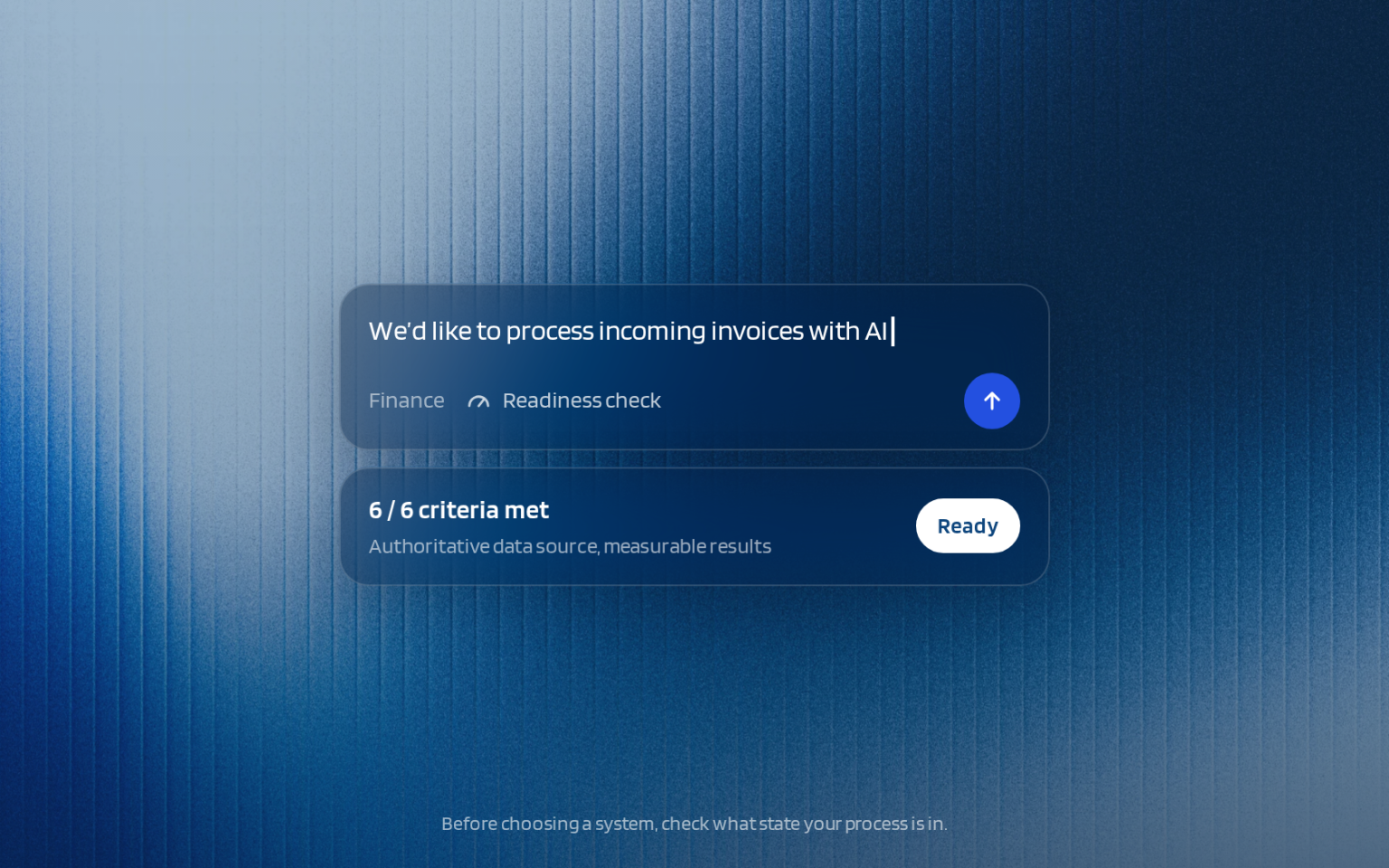
Thinking about implementing a new ERP, CRM, workflow system or AI solution? It’s easy to assume that the right technology will solve the problems that have built up in your operations. Experience, however, often shows otherwise: if the process isn’t in order, digitalization simply carries the existing errors forward. That’s why the first question of a successful project is not which system to choose, but what is worth digitalizing – and what state the process in question is in.

Digitalization doesn’t start with choosing software
When a company launches a digitalization project, the conversation quickly turns to technology: what kind of system is needed, how much it costs, how long it takes to implement, whether it can be connected to existing solutions, and what AI features it offers.
These are important questions – but not necessarily the first ones. Before a process becomes an IT solution, it’s worth clarifying how it works today: who initiates it, who makes the decisions, where the data is created, where it gets stuck, and which steps have survived simply because “that’s how we’ve always done it”.
If there is no clear answer to these questions, the software won’t provide one either. Technology automates what we define for it. It can make a well-functioning process faster, more transparent and more measurable – but it can just as easily set a disorganized one in stone.
How can you tell a process isn’t ready yet?
An organization doesn’t have to be visibly dysfunctional for its processes to be worth putting in order. Many problems become so ingrained in the daily routine that nobody notices them anymore.
- different colleagues or departments perform the same task differently;
- there is no clearly designated process owner;
- the same data appears in several Excel spreadsheets or registers;
- a significant share of approvals happens by email;
- the same data is entered manually into several systems;
- handling exceptions always requires a case-by-case decision;
- lead time, bottlenecks or the number of errors cannot be measured reliably.
If several of these are present at the same time, it’s advisable to examine the operation itself before choosing a new system.
What happens when you digitalize a disorganized process?
At first glance, it may seem logical that the system will enforce order. To some extent, it can: it can require mandatory fields, manage approval chains and assign tasks. The problem begins when there is no clear answer as to which rules need to be built into the system.
In that case, organizational questions surface in the middle of the IT project. Debates about processes find their way into the specification and testing, the need for customization grows, the project gets longer, and costs rise. The end result may work technically, yet it won’t be any easier to work with.
Simplify first, then automate
One of the greatest opportunities of digitalization is not making the current process electronic, but asking a question beforehand: is every current step actually necessary?
A five-level approval doesn’t become modern just because decisions are now made in a mobile app. Perhaps three approval levels would be enough. Nor is a manually maintained Excel file necessarily a problem because it’s in Excel: the data may already be available in another system, so it shouldn’t need to be entered again.
Process streamlining before digitalization therefore doesn’t first ask how an existing step can be automated, but whether it is needed at all.
A simple example: a purchase request
Suppose that at a company, purchasing a new piece of equipment works like this: the employee emails their manager, the manager replies, finance asks about the cost center, the request is added to an Excel spreadsheet, larger amounts require an additional approval, quotes pile up in different inboxes, and finally someone enters the order into the ERP system manually.
Of course, a workflow solution can be developed for this. Before that, however, it’s worth deciding: what data the request requires, which approval level belongs to which amount threshold, who the process owner is, where the authoritative budget data is, what the exceptions are, and which data can be passed to the ERP automatically.
If these questions are settled in advance, digitalization will no longer be an electronic copy of the old process, but a shorter, clearer and more measurable way of working.
When is a process ready for digitalization?
A process can generally be digitalized safely if:
- its start and end can be clearly defined;
- it has a designated process owner;
- decision levels and responsibilities are clear;
- the authoritative data source can be identified;
- exceptions are regulated;
- the outcome can be measured with at least a few basic metrics.
Not everything has to be perfect. The goal is to make sure the most important business questions don’t come up in the middle of development or system implementation.
Not every problem needs a new system – and not everything needs AI
One of the most important outcomes of a process assessment is often the discovery that certain problems don’t require new software at all. Eliminating an unnecessary approval round, clarifying responsibilities or establishing consistent document management is a matter of organization.
In other situations, a Power Automate flow, a Power Apps application or better use of an existing Dynamics 365 system may be enough. And of course, there are processes where introducing a new solution is genuinely justified.
The same applies to AI. If a process is slow because the same data has to be entered manually three times, the data flow should be fixed first. But if information needs to be extracted from large volumes of emails or documents, requests classified, summaries written or decisions prepared, AI can deliver real added value.
So the question is not where AI can be used, but where it creates business value.
Grepton’s approach: business questions before technology
Grepton’s corporate consulting approach is based on the principle that digitalization is not an IT task in itself. First, the actual operation, the problematic and unnecessary steps, the responsibilities and the decision points need to be uncovered.
Only then can you decide where organizational change, automation, system integration or a new technology solution is needed. This is especially important in back office, finance, procurement, logistics and HR, where a single process often runs across several departments and IT systems.
Once the process is in order, the right technology solution can be designed – whether it’s Dynamics 365, Microsoft Power Platform, custom development, integration or AI-based automation.
Where should you start?
There’s no need to redesign the entire company’s operations at once. It’s worth starting with a process that affects many colleagues, involves significant manual work, regularly gets stuck or generates a lot of follow-up questions.
The baseline should be measured before any change: the total lead time, the number of manual steps, the volume of follow-up questions and errors, and how much working time the process ties up. That way, you’ll later be able to see concretely whether digitalization has sped up operations, reduced administration, and how much capacity it has freed up.
Put your operations in order first, then choose the technology
A new system will not bring order to your processes on its own. Well-chosen technology, however, can support an operation extremely effectively once its rules, responsibilities and goals are clear.
Good digitalization doesn’t start with choosing a system. It starts with knowing what kind of operation you want it to support.