On-prem AI – artificial intelligence on your own infrastructure
An enterprise AI solution that runs on your company’s own infrastructure: data stays on-site, costs are predictable, and usage can be logged and audited. From hardware through rollout to operations, we provide everything from a single source.
Three challenges that companies using AI face more and more often
For many companies, AI is no longer an experiment but part of everyday work. With that, questions that were less visible during the early rollouts are becoming increasingly important. On-prem AI offers a practical answer to the following three challenges.
At the end of the month the invoice arrives, but it is not always clear exactly what it is made up of. What’s more, it is no longer just users but also AI agents that consume capacity, making usage harder to forecast.
An external provider can change its prices, terms of use or even the availability of its service at any time. If day-to-day operations depend on such a service, that is a business risk.
When using public AI tools, it is difficult to trace exactly which company data has ended up in external systems. Meanwhile, the EU AI Act, NIS2 and DORA are placing ever greater emphasis on transparent, verifiable and documented operations.
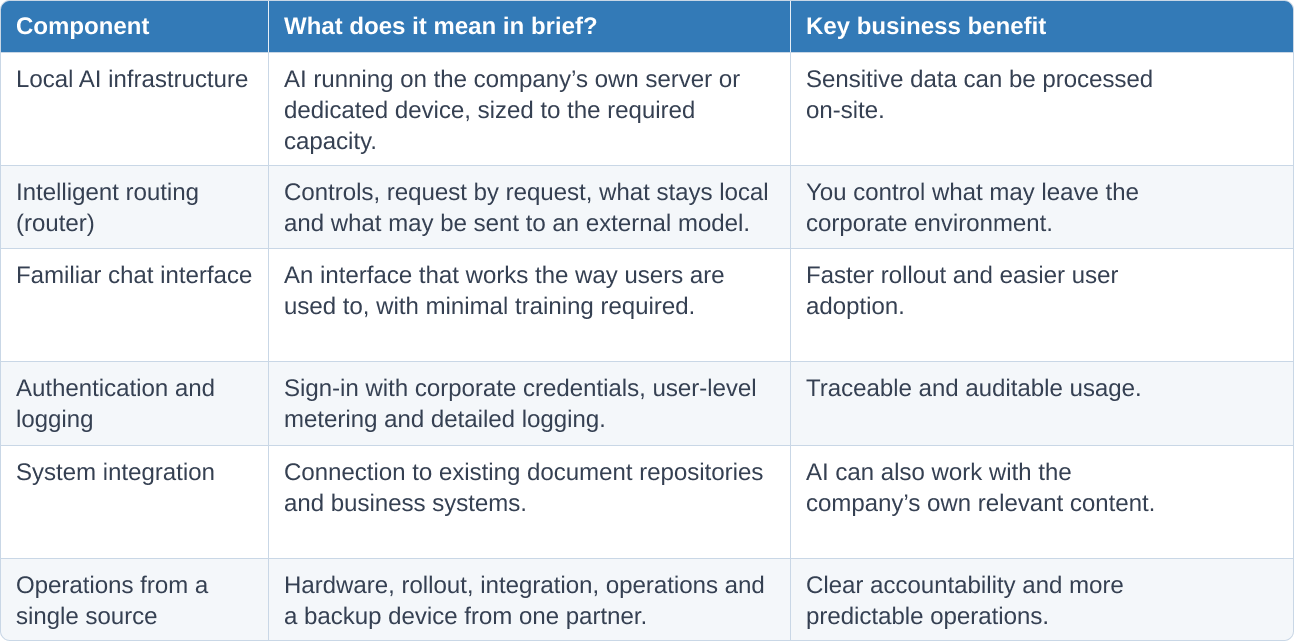
We don’t deliver a single product, but a complete, working and managed solution: from the hardware and user interface through access management all the way to the backup device.
From compact, entry-level devices to server-based solutions, we size the required capacity to match your number of users and planned usage.
From compact, entry-level devices to server-based solutions, we size the required capacity to match your number of users and planned usage.
The system decides, request by request, what stays within the corporate environment and what may be sent to an external large language model. This lets you control which data must never leave the company.
Users don’t need to learn a new way of working: they can use AI through an interface similar to the chat experience they already know – only within the company’s own environment.
Employees sign in with their existing corporate identity. Usage can be measured and logged per user, so it is always possible to trace exactly who used the system and how.
We connect the solution to your document repositories and business applications while preserving your existing permission structure.
From procuring the equipment through rollout and integration to ongoing operations and the backup device, one partner is responsible for the entire solution.
What does the company get in practice?
Tasks handled locally are processed within the company’s own infrastructure, so personal data and trade secrets are not unnecessarily passed on to third parties. It also reduces dependence on a single external AI provider.
Usage is logged: you can trace who used what, and which requests were sent to an external service. This supports the documentation and auditability expected under NIS2, DORA and the EU AI Act.
The cost of local capacity can be planned in advance, so you don’t find out only at the end of the month how much your AI usage cost. The solution can also be tailored to the company’s own documents, processes and tasks.
For companies where AI is no longer an experiment but an everyday work tool, and where – because of the value of the data, the business risk or the regulatory environment – it matters where and how processing takes place.
Typical industries
• Financial institutions and insurers
• Healthcare
• Public sector
• Manufacturing companies
• Software development teams
Typical decision-makers
• CIO / Head of IT – for whom operability and integration are the key questions
• CISO / Head of Information Security – for whom the data path, access control and logging matter most
• Head of Development – for whom daily productivity and protecting the codebase are the main concerns
• CFO / Finance Director – for whom predictable costs and return on investment are decisive
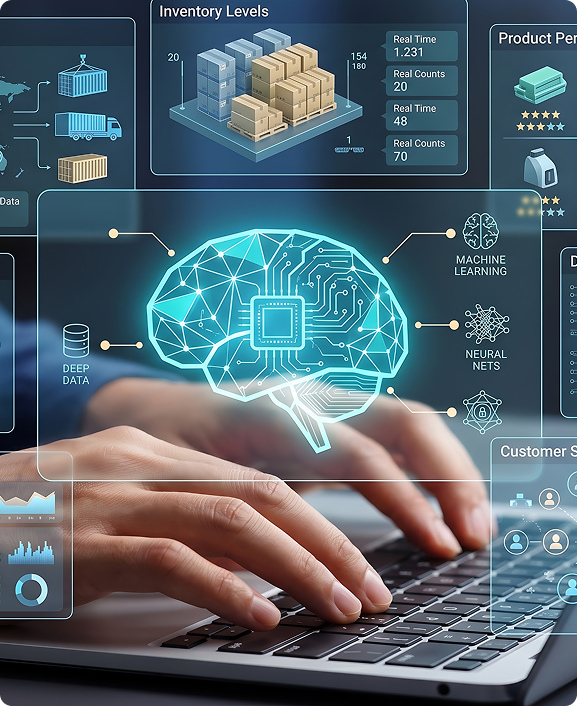

We don’t just offer yet another AI tool: as a systems integrator, we help AI truly fit into the company’s existing identity, access, security and operations environment. Downloading a model is easy – building a reliable enterprise solution is a far more complex task.
- Integrator mindset: the solution fits into your existing identity, access and operations environment rather than running separately from it.
- First-hand experience: we first deployed it in our own live internal processes, not just in a demo environment.
- Open-licence software layer: the model can be replaced later, with no hidden model licensing costs.
- Complete infrastructure from one team: alongside AI, the server environment, security, Microsoft and Linux systems, and cloud integration are all handled by the same team.


We examine which tasks AI can bring the most value to, and where the fastest return can be expected.

Based on the number of users and the planned use cases, we determine the required capacity.

We start with a well-defined task, with predefined and measurable target outcomes.
We set up corporate authentication, permissions, logging and the necessary system connections.

We roll the solution out to a wider user base, set up the backup device, and then hand it over for ongoing operations.
Data handled locally stays within the corporate environment, and usage is logged. This means that during an audit you can trace who used the system and how, and which requests were sent to an external service. This supports the documentation and auditability required under NIS2, DORA and the EU AI Act.
We don’t promise compliance – we provide the technical foundations for demonstrable, verifiable operations.
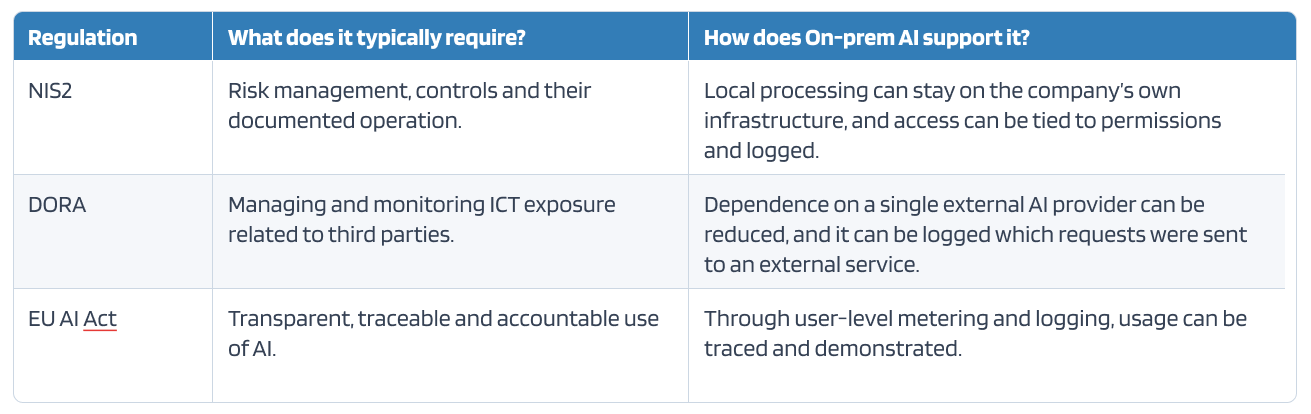
Data handled locally stays within the corporate environment, and usage is logged. This means that during an audit you can trace who used the system and how, and which requests were sent to an external service. This supports the documentation and auditability required under NIS2, DORA and the EU AI Act.
An internal report that used to take days to prepare can now be compiled in significantly less time, while sensitive data stays on-site.
Refactoring legacy software with a locally running model, without sending the codebase to an external provider.
The development team’s daily work is supported by a locally running, centrally managed AI tool.
The return on investment depends on the use case, the utilisation rate and the external AI costs replaced; we quantify this during the assessment.
Frequently asked questions
What does on-prem AI mean?
On-prem AI means that artificial intelligence runs on the company's own infrastructure, not exclusively on an external provider's systems. This allows sensitive data to be processed on-site, while usage can be controlled and logged at company level.
Won't it be slower than the cloud?
With proper sizing, the difference in everyday use is typically not significant. There may be short waits at peak times, but in return, local capacity is not tied to a monthly usage quota.
If it runs locally, do we get a weaker model?
For everyday, recurring business tasks, a well-chosen local model is often sufficient. When needed, more complex requests can be routed to larger external models – in a controlled and logged way.
Can data still leave the company?
Only according to the rules you set. The intelligent router determines which requests stay local and which may be sent to an external model; requests forwarded externally can be logged.
How does it help meet the requirements of NIS2, DORA and the EU AI Act?
The solution supports demonstrable operations: processing can be controlled, access can be managed, and usage can be logged and traced at user level. This supports, but does not on its own replace, the organisation's compliance processes.
How much hardware does it require?
The required capacity depends on the number of users, the chosen models and the planned tasks. Several configurations are possible, from compact devices to server-based solutions; we provide a specific recommendation during the assessment.
How much does it cost, and does it pay off compared to the cloud?
The cost depends on the required capacity and the operations package, but it can be planned in advance. Whether and when it becomes more cost-effective than cloud usage can be determined based on your actual usage patterns – we quantify this during the assessment.
Do employees have to replace the tools they're used to?
Not necessarily. Users can work in a familiar chat interface and sign in with their existing corporate credentials, so there is no need to learn an entirely new way of working.
Can the model be replaced later?
Yes. We build on an open-licence software layer, so the model can later be replaced with a newer one or one better suited to a different task, without having to rebuild the entire solution.
How long does the rollout take?
We start with a well-defined pilot project, then gradually expand usage based on the results. We provide the exact timeline after the assessment and sizing.
Request a free consultation! In a short online call, we’ll review which tasks AI running on your own infrastructure can bring the most value to, and what rollout would mean in your corporate environment.
During the consultation, we will:
• Identify the 2–3 tasks where AI can create the most business value.
• Estimate the required capacity based on your number of users and planned usage.
• Discuss what level of logging and demonstrability your regulatory environment requires.