SmartCOMM™ Customer Communications Management Software
With SmartCOMM™, the business side can centrally manage the templates, content and rules of customer communications while corporate control is maintained. Personalized communications can be produced for multiple channels from data arriving from back-end systems, and business users can manage a significant part of everyday content changes faster and directly. As a Smart Communications partner, Grepton guides the implementation from assessment and integration through migration to Hungarian-language support.
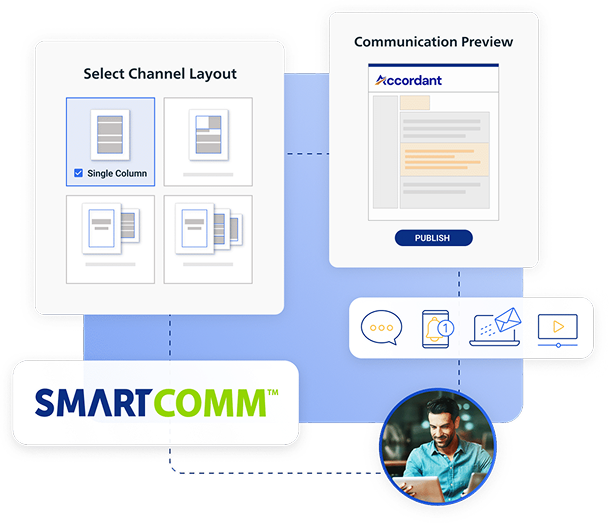
Back-end systems provide the data. SmartCOMM manages how we communicate.
SmartCOMM does not work instead of the CRM or ERP. It takes customer and transactional data from these and other business systems, then assembles the appropriate communication based on templates, business rules and approved content.
Authorized business users can directly manage a significant part of everyday content and template changes. This allows the business side to respond faster to change, while approval, version control and compliance control remain in place.

From CRM, ERP, core and other enterprise systems.
Central management of templates, content, business rules and approvals.

Personalized communications via email, SMS, PDF, print and digital channels.

Grepton supports the entire implementation lifecycle: business assessment, solution design, system integration, migration from legacy systems, as well as Hungarian-language operations and support.
What does the company get in practice?
A significant part of everyday template and content changes can also be managed directly by business users, which can shorten the lead time of changes.
Templates, reusable content blocks and business rules can be managed in one place, so the same change does not have to be implemented separately in multiple systems.
From the same business data, the appropriate content can be produced for email, SMS, PDF, print and digital channels.
Approval workflows, audit logging, and locked, controlled content blocks – mandatory texts can be updated centrally.
What the SmartCOMM platform can do

Central template library and reusable content blocks. A significant part of everyday changes can also be managed directly by business users, allowing them to respond faster to business needs.
Print (PDF, PostScript, AFP), email, SMS and digital outputs from a common data source, with formatting appropriate to each channel.
Personalized documents created in real time by case handlers or customers – for example letters, quotes and contracts.
Approval workflows, full audit logging, and locked, controlled content. Mandatory legal texts can be maintained centrally.
Multi-tenant SaaS architecture with a documented API set, flexible scalability, continuous updates and enterprise-grade availability.
Documented APIs and pre-built integrations; Grepton also builds custom connections to Microsoft Dynamics 365, CRM, ERP and internal systems.

It is especially valuable in regulated sectors with high communication volumes.
Insurance
Financial services
Telecommunications
Utilities and energy
Public administration
Health
What documents and processes can it be used for?
Contracts, general terms and conditions (T&Cs), NDAs, agreements
Customer letters, notifications, reminders, payment demands
Invoices, statements, balance notifications, receipts
Onboarding of new customers and members, welcome packs, account opening
Policy administration, renewals, beneficiary changes
Claims communication, FNOL (first notice of loss)
Privacy and regulatory notices, ID cards
Not just technology, but local implementation and integration expertise
- Business assessment, solution design, integration, migration and operations from a single source
- Hungarian-language project management and support
- Integration with Dynamics 365, CRM, ERP, BI and custom systems
- Migration experience from legacy CCM and document generation systems
- Industry experience in regulated environments
domestic experience
experienced professionals
Hungarian-language support
Frequently asked questions
What is the difference between CCM and CRM?
CRM manages customer relationships and sales processes. CCM (Customer Communications Management) is used to create, govern and deliver outbound customer communications – such as letters, invoices, contracts and notifications – across multiple channels. The two systems complement each other well: from data stored in the CRM, SmartCOMM can produce personalized communications.
How long does an implementation take?
The time required for implementation depends on the number of channels, the volume of templates, the integrations and the migration task. A well-defined first phase can typically be delivered within a period ranging from a few weeks to a few months. Grepton starts with an assessment phase, on the basis of which a detailed schedule and proposal are prepared.
Can it be integrated with our existing systems?
Yes. SmartCOMM has a documented API set and pre-built integrations. Grepton also implements custom integrations, for example towards Microsoft Dynamics 365, CRM, ERP and other enterprise systems.
Does it run in the cloud or on our own infrastructure?
SmartCOMM is a cloud-based, multi-tenant SaaS solution that provides continuous updates and flexible scalability. During implementation, we adapt the integration and data management architecture to the company's requirements.
How does it support compliance?
Through approval workflows, audit logging and locked, controlled content blocks. Mandatory legal texts can be updated centrally across the entire communications portfolio. During implementation, we align the data management and access processes with the regulatory requirements of the given organization.
Is a developer needed to modify templates?
A significant part of everyday content and template changes can also be managed directly by business users. This allows them to respond faster to business needs, while for more complex modifications and integration tasks, the Grepton team provides support.
Let’s look together at how the management of customer communications can be made faster, more flexible and centrally controlled.